
How to Know If Your Grandfather Clock Needs Repair or Full Restoration: A Kenosha Owner's Guide
Knowing when a grandfather clock needs simple repair versus full restoration can save time, money, and preserve a family heirloom for generations. Many Kenosha, WI, homeowners inherit tall case clocks that show their age in ways that are easy to miss until the clock stops completely. This guide walks through five key diagnostic signals and explains what each one means for grandfather clock restoration decisions.
Kenosha sits in the southeastern corner of Wisconsin, where cold winters, humid Lake Michigan summers, and older housing stock contribute to wear on antique mechanical clocks. Homes in neighborhoods like Uptown, Library Hill, and the lakeside historic district commonly house floor clocks dating from the mid-1800s through the 1970s. German-movement clocks, including Hermle and Kieninger models, are especially common in the area.
Repair vs. Restoration: What Is the Real Difference?
Repair targets a specific broken or worn component, leaving the rest of the movement untouched. Grandfather clock restoration is broader: the entire movement is disassembled, ultrasonically cleaned, and recalibrated, with bushings replaced throughout. A clock that has not been serviced in 10 or more years often benefits from full restoration rather than repeated single repairs.
Five Signals and What They Tell You
Signal 1: Irregular or Skipped Chimes
Chime irregularity often points to worn or dried lubricant on the chime train, a bent hammer arm, or a chime-lifting pin that has lost tension. When only the chime is affected and timekeeping remains accurate, a targeted repair may be sufficient. Persistent chime problems, however, can be an early indicator that grandfather clock restoration is the more practical solution.
Signal 2: Mainspring Fatigue
A mainspring-driven clock that runs fast, then slow, then stops shows classic mainspring fatigue. This is a repair-level fix when the rest of the movement is clean and bushings are still in good shape. If the clock has not been oiled in many years, the surrounding parts are likely also worn, and grandfather clock restoration becomes the more practical choice.
Signal 3: Worn Bushings
Bushings are small metal sleeves that hold the movement's gear arbors in place. Over time, they elongate and allow gears to wobble, throwing off gear mesh and causing the clock to stop or run erratically. Because bushings wear throughout the movement at a similar rate, wear found in one location often signals that others are close behind. Full grandfather clock restoration is typically the better recommendation when bushing wear is widespread.
Signal 4: Case Damage
Surface case issues, including warped panels, cracked molding, peeling veneer, or a broken door hinge, do not necessarily indicate a need for movement restoration. However, a warped case can put the clock out of level, directly affecting pendulum swing and timekeeping accuracy.
Kenosha's seasonal humidity swings between dry winter heating and humid Lake Michigan summers accelerate wood movement in older cases, particularly those with original hide-glue joinery.
Signal 5: Movement Corrosion
Visible corrosion on brass plates or steel pinions is a serious finding. Light surface oxidation on brass may be addressed during cleaning. Active rust on steel parts can compromise structural integrity and signal that grandfather clock restoration is likely necessary. Corrosion often develops in clocks stored in damp basements or garages, which is not uncommon for clocks passed down through Kenosha families.
A Simple Decision Framework
One signal present: A targeted repair is often the right starting point. Ask a technician whether the rest of the movement appears clean and adequately lubricated.
Two or three signals present: The clock may benefit from a movement service beyond a single fix. Ask specifically about bushing inspection and full lubrication.
Four or five signals present, or the clock has not been serviced in 10-plus years: Full grandfather clock restoration is typically the more cost-effective path. Repeated single repairs on a deeply worn movement can cost more over time than addressing everything at once.
What the Restoration Process Looks Like
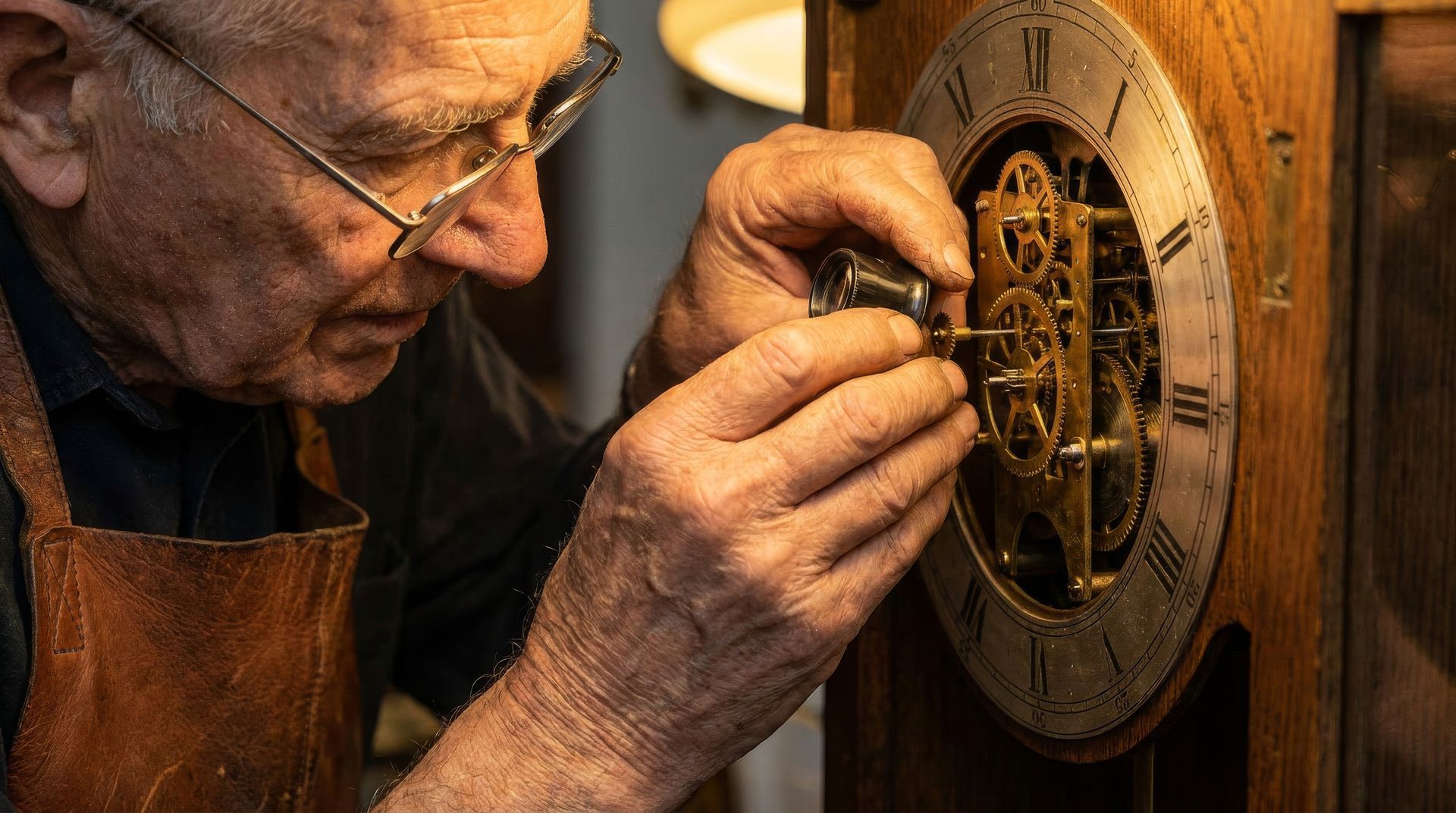
Full grandfather clock restoration for Kenosha, WI, customers follows a consistent process. The movement is removed from the case, individually inspected, and ultrasonically cleaned to remove decades of dried oil and debris. Worn bushings are replaced, the movement is reassembled, lubricated with appropriate clock oils, and regulated for accurate timekeeping. The case is inspected for level and structural issues. Learn more on the clock repair services page.
Is It Worth Restoring an Older Grandfather Clock?
Grandfather clocks made before the 1980s were often built with higher-grade materials and more durable movements than many modern equivalents. Restoration can preserve both the sentimental value and the mechanical integrity of a well-made piece.
How Often Should a Grandfather Clock Be Serviced?
A mechanical grandfather clock typically benefits from professional servicing every three to five years. Humidity and temperature swings common in Southeast Wisconsin may shorten that interval.
Can I Tell If My Clock Needs Restoration Without Taking It Apart?
Several external signs may indicate a deeper issue: the clock stops repeatedly despite being wound, chimes are inconsistent, the pendulum swings unevenly, or the clock gains or loses significant time daily. An in-person assessment by a technician can confirm internal wear.
Does Case Damage Mean the Movement Also Needs Restoration?
Not necessarily. Case and movement issues are often independent. However, a warped or off-level case can affect pendulum performance. A trained horologist can determine whether the movement also needs attention.
Let an Expert Evaluate Your Clock
Hawkins Brass and Clocks, serving Kenosha, WI, and the surrounding Kenosha County area, offers full in-house clock repair and grandfather clock restoration backed by over 50 years of family-owned horological expertise. Whether your clock is showing one signal or all five, the team can assess it and recommend the right course of action. Call (414) 258-1144 to speak with a specialist, or reach out through the contact page to schedule an assessment today.